Sanctuary Banner
July 23, 2008


Email envalope
Have a Question or Comment?
What can we do to make this site more useful to you?

FKNMS Privacy Policy

Note: Adobe Acrobat Reader required for PDF documents.
Problems accessing PDF documents?
Download the document to disk:
Mac Users: Option-click
PC users: Right-click


Last Updated: November 15, 2006

Yellow WaveYellow Wave

Comments and Responses to date

History


FKNMS Map

The Florida Keys National Marine Sanctuary was established in 1990 under legislation laid out in the National Marine Sanctuary Act of 1972 and following the earlier designation of the Key Largo and Looe Key National Marine Sanctuaries in 1975 and 1981. The regulations established in the Final Management Plan for the Florida Keys National Marine Sanctuary came into effect in 1997. As part of the FKNMS Final Management Plan, provisions were made for the enforcement of Sanctuary Regulations under an Enforcement Action Plan.

Law Enforcement in the Florida Keys National Marine Sanctuary is a cooperative partnership between the National Oceanic and Atmospheric Administration (NOAA) the State of Florida, Florida Fish and Wildlife Conservation Commission (FWC) and is carried out by the FKNMS Law Enforcement Team.


How does the FKNMS Law Enforcement Program work?

NOAA’s primary law enforcement objective in the Sanctuary is to achieve resource protection by gaining compliance with the sanctuary regulations and other Federal and State statutes that apply within the FKNMS. NOAA is also concerned with effective enforcement of all Federal, State, and local statutes that protect the natural, cultural, and historical resources with the Florida Keys National Marine Sanctuary


FKNMS Law Enforcement Philosophy

The law enforcement program of the Florida Keys National Marine Sanctuary (FKNMS) is an essential component of resource protection and boating safety with the Sanctuary. The goal of Sanctuary Law Enforcement is to educate boaters and enforce Federal and State laws regarding boating safety, resource protection and Sanctuary regulations. These education and enforcement efforts are best achieved by maintaining patrols throughout the Florida Keys National Marine Sanctuary. Officers with the FKNMS routinely patrol from Key Largo to the Dry Tortugas, in both State of Florida and Federal waters. These routine patrols provide quick response to violations or emergencies. All Sanctuary officers are Florida State Law Enforcement Officers with the authority to investigate, document, and assess civil or criminal penalties for violations of Federal, State, County or City laws or ordinances under Florida Statute 370.021(8)(a)


Integrating Enforcement Efforts

Across the United States, Federal, State, and local agencies are increasingly joining forces and targeting whole coastal ecosystems including rivers, bays, estuaries, and coastlines for comprehensive management and enforcement actions. Federal, State, and local laws provide government agencies with a variety of tools to protect coastal resources. In so doing, these laws strengthen law enforcement capabilities by allowing agencies to build on each other’s expertise and share physical resources. Federal, State, and local agencies in the Keys are implementing this process of integrating efforts. In addition, local residents and frequent Sanctuary users are helping by detecting and reporting various violations and groundings, monitoring water quality, and submitting witness statement forms that document Sanctuary violations


Challenges to FKNMS Enforcement

Various Aspects of the Florida Keys National Marine Sanctuary result in numerous challenges to enforcement. Some of these challenges include:

  • No single point of entry. Vessels may easily access the Florida Keys at any geographic point. This is a concern to enforcement with regards to resource violations, smuggling violations, and our nations security.
  • Large geographic boundaries. The FKNMS is roughly twenty-eight hundred square miles and is patrolled by approximately thirty-six Sanctuary and FFWCC (Florida Fish and Wildlife Conservation Commission) officers.
  • Three million annual visitors. New people arrive in the Keys every day to live, work or recreate. Many of our visitors have never seen the Atlantic Ocean or the Gulf of Mexico and have little knowledge or understanding of the environment or the resources.
  • Intense use of the marine environment. The boating, diving and fishing industries continue to grow as the population and influx of tourists grow. As a strong basis of our economy in the Florida Keys we greatly appreciate our tourists. We must also equally appreciate and care for our natural resources here in the Florida Keys.
  • Diverse Languages. Many of our residents and our tourists are from other nationalities. Many do not speak English and fail to understand the nature of the violation that may have been committed.
  • Commercial and recreational use of marine resources. Numerous state and federal laws regulate the many types of commercial and recreational fishing. Many of these laws vary from time to time to prevent over fishing and protect our natural resources. In addition to the fishing industry, the boating industry plays a role in the use of marine resource. To protect our resources in the Florida Keys several areas have been closed to Personal Watercraft and motorized vessels.
  • A public lack of awareness to the health of the marine environment and the health of the marine resources. Research is continually being conducted to test the effects of man on the environment. The negative effect from littering, fuel spills, and boating injuries to Florida’s Manatees and turtles, and commercial over fishing of the world oceans have become obvious.
  • Disseminating regulations to the Sanctuary Users. Many of the visitors to the Florida Keys fail to make themselves aware of the state and federal regulations regarding fishing and boating. Brochures are available at many locations throughout the Florida Keys.

Successes In Sanctuary Enforcement

Gaining compliance is a continuous challenge. Despite the challenges there have been many successes in Sanctuary enforcement.

  • Promote public stewardship of the marine environment through enforcement and education. As the Florida Keys National Marine Sanctuary has developed so has the public awareness of the need to care for the natural resources.
  • Voluntary compliance through education. Many of the people that visit the FKNMS each year have learned and understand that a need exists to change some of our philosophies and ideas as we learn more about environment and the species that live within the environment.
  • Maintain active relationships with citizen groups. The community has welcomed the FKNMS and appreciates the law enforcement services, which protect the environmental habitats of our marine resources.
  • Encourage citizens and waterfront communities to report violations. Violations that are not addressed affect the marine resources of the Florida Keys. This is especially true of vessel groundings. Through enforcement and education, fewer vessel groundings are occurring. When a vessel grounding does occur, it is more frequently recognized that, the operator of the vessel is no longer attempting to free the vessel by powering free. Instead the operator of the vessel will wait for high tide to float the vessel causing only minimal damage to the sea grasses.
  • Strengthen partnerships with local, state and federal agencies. The FKNMS enforcement team works hand in hand with all of the other law enforcement agencies in the Florida Keys to aid them in performing their duties when assistance is needed. The FKNMS relies on many law enforcement agencies to assist Sanctuary Officers. The Sanctuary Officers value the knowledge and expertise gained by officers from other law enforcement backgrounds.
  • Protect the marine resources of the Florida Keys. Our continued efforts in law enforcement and education have resulted in a significant drop in violations over the past five years. Most of the boaters, commercial fishermen and recreational fishermen, living in or frequently visiting the Florida Keys, have become aware of the state laws and the Sanctuary regulations and have accepted them as a means of protecting the coral reef, sea grasses, and numerous marine species.

Gaining Compliance

Education and outreach are primary management objectives that are targeted at getting information out to the public regarding Sanctuary regulations and other pertinent information. The goal is to have a knowledgeable and well-informed public who are the primary users of Sanctuary resources. Over the years, personal observations have revealed that the majority of the general public is environmentally alert, aware and concerned. They will comply with resource laws if they are aware of them and will not intentionally break the laws. A small percentage of the public will not go out of their way to learn or obtain information about resource laws. They will go about their business of recreating themselves, until they encounter a law enforcement officer. Very few members of the public go about their business and pay no attention to resource laws and fail to obey them. These few members are those that gamble on the slim chance of being caught. They rely on the vastness of the ocean and their ability to see the officers approaching. They conclude that it is part of the cost of doing business. They don't care. These are the types of persons that make law enforcement programs necessary. It is critical to have enforcement programs in place to firmly and decisively prosecute these violators. If these violations are not addressed they will erode the general compliance from the other groups mentioned and create a general attitude of complacency among all of those persons utilizing the resources of the Florida Keys for commercial or recreational purposes

FKNMS Penalty Schedules


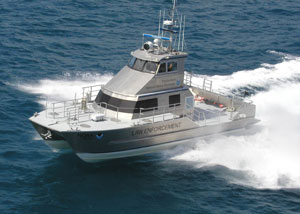
Officers and Vessels

The FKNMS Law Enforcement Team is comprised of:


Major Enforcement Initiatives

DOC | NOAA | NOS | ONMS | Florida Keys National Marine Sanctuary
Back to Top